
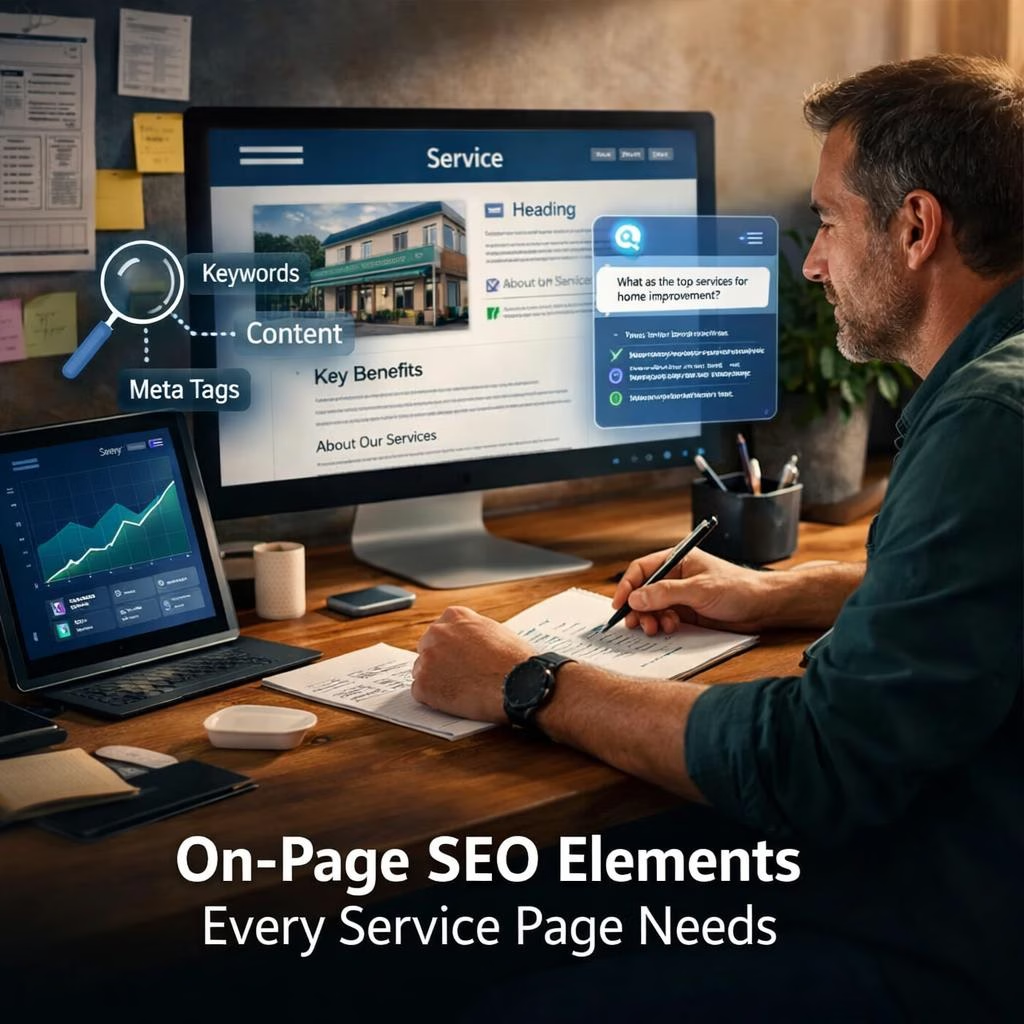
A service page is one of the hardest-working pages on your website. It needs to rank in search results, communicate your value clearly, and convert visitors into paying customers — all at the same time. Most service pages fail at one or more of these jobs, not because the service is bad, but because the page wasn’t built with both search engines and real people in mind.
Getting this right requires more than sprinkling a keyword into a paragraph. Search engines evaluate dozens of signals to determine whether your page deserves to rank. Visitors evaluate your page in seconds to decide whether they trust you enough to reach out. The good news is that the same elements that satisfy search engines also tend to build trust with humans — so optimizing for both goals is very achievable.
This guide walks through every critical on-page SEO element your service page needs, from technical fundamentals to content strategy and trust signals. If you’ve been wondering why your service pages aren’t generating leads, understanding how local SEO drives calls and inquiries for service businesses is a great place to start building that foundation.
Align the Service Page With Search Intent
Before writing a single word, you need to understand exactly who you’re writing for and what they’re trying to accomplish when they land on your page.
Define the target customer, service, and primary keyword
Every strong service page starts with clarity. You need to know your target customer, the specific service you’re offering, and the primary keyword that connects the two. Vague pages that try to cover too much ground rank for nothing and convert nobody.
Start by asking: who is searching for this service, and what words are they actually typing? Use tools like Google Search Console, Google’s autocomplete, or keyword research platforms to find the exact phrase your ideal customer uses. That phrase becomes your primary keyword — the anchor around which everything else is built.
| Element | What to Define | Why It Matters |
|---|---|---|
| Target Customer | Demographics, pain points, location | Shapes tone, content, and offers |
| Service Offered | Specific deliverable or outcome | Prevents vague, unfocused pages |
| Primary Keyword | Exact phrase customers search | Drives keyword optimization strategy |
| Geographic Focus | City, region, or service area | Supports local search visibility |
Match the page to informational, commercial, or local search intent
Search intent tells you what a visitor actually wants when they type a query. Someone searching “what is HVAC maintenance” wants information. Someone searching “HVAC maintenance service near me” wants to hire someone. Your service page should target commercial or local intent — not informational intent, which belongs on blog posts or FAQ pages.
Mismatching intent is one of the most common reasons service pages don’t rank. Google is very good at identifying what type of content belongs at the top of results for a given query. If your page reads like an educational article when the searcher wants to hire someone, it won’t rank well regardless of how well-written it is.
Build a clear page structure around customer questions and needs
Once you know your audience and intent, structure the page around the questions your customer is actually asking. What does the service include? How does the process work? How much does it cost? Why should they choose you over a competitor?
Answering these questions in a logical order creates a natural page flow that keeps visitors engaged and reduces bounce rate. A well-structured page also makes it easier for search engines to understand your content and match it to relevant queries.
Optimize Core On-Page SEO Elements
The technical building blocks of on-page SEO are non-negotiable. These elements directly influence how search engines read, index, and rank your page.
Write a unique title tag and compelling meta description
Your title tag is the single most important on-page SEO element. It tells search engines what your page is about and appears as the clickable headline in search results. Every service page needs a unique title tag that includes your primary keyword and ideally your location if you serve a specific area.
The meta description doesn’t directly affect rankings, but it significantly affects click-through rate. Write it like a short pitch — what does the visitor get, and why should they click? Keep it under 160 characters and make it specific to the service.
Use one clear H1 and descriptive H2 and H3 headings
Your H1 is the main headline on the page. There should be only one, and it should include your primary keyword naturally. Think of it as the title of the page from the visitor’s perspective — it should immediately confirm they’re in the right place.
H2 and H3 headings organize the rest of your content into scannable sections. Use them to break up long content, introduce subtopics, and incorporate related keywords. Descriptive headings also help accessibility tools and screen readers navigate your page, which is a signal Google takes seriously.
Create a descriptive URL and optimize image file names and alt text
Your URL should be short, readable, and keyword-rich. Avoid auto-generated URLs with numbers or random strings. A URL like `/plumbing-services-manchester-nh/` is far more effective than `/page?id=4829`.
Every image on your service page should have a descriptive file name and alt text. Instead of `IMG_0034.jpg`, use `bathroom-remodel-concord-nh.jpg`. Alt text serves two purposes: it helps visually impaired users understand the image, and it gives search engines additional context about your page content.
Use the primary keyword and related terms naturally without keyword stuffing
Keyword optimization means using your primary keyword in strategic locations: the title tag, H1, first paragraph, at least one H2, and naturally throughout the body. It does not mean repeating the keyword every other sentence.
Use LSI keywords — related terms and phrases that naturally surround your topic — to give search engines a fuller picture of your content. For a landscaping service page, related terms might include lawn care, mulching, seasonal cleanup, and yard maintenance. This approach signals topical depth without forcing awkward repetition.
Create Useful Service Content That Builds Trust
Rankings get people to your page. Content quality is what keeps them there and convinces them to contact you. This section is where most service pages fall short.
Explain the service, process, benefits, deliverables, and pricing factors
Visitors want to know exactly what they’re getting. Don’t assume they understand your service the way you do. Explain what the service includes, how the process works from start to finish, what they’ll receive at the end, and what factors influence pricing.
You don’t have to publish exact prices if your work is custom-quoted, but you should address pricing in some way. Saying nothing about cost creates friction and often sends visitors to a competitor who is more transparent. Even a general range or a list of factors that affect cost builds confidence.
- Describe what happens at each stage of your process
- List specific deliverables the customer receives
- Explain what’s included and what’s not
- Address common pricing variables honestly
Demonstrate expertise with proof, credentials, reviews, case studies, and guarantees
Trust signals are critical for service pages. Visitors are often considering spending significant money with someone they’ve never met. Social proof and reviews, credentials, certifications, case studies, and guarantees all reduce the perceived risk of hiring you.
If you’re building or redesigning your service pages, understanding what actually makes a small business website convert visitors will help you prioritize which trust elements have the biggest impact on lead generation. Real results and real customer voices carry far more weight than generic claims.
- Display star ratings and written reviews prominently
- Include before-and-after photos or project case studies
- List relevant licenses, certifications, or industry memberships
- Offer a satisfaction guarantee or clear service warranty
Address objections and include locally relevant details where appropriate
Every potential customer has hesitations. They might worry about cost, timeline, disruption, or whether you actually serve their area. Addressing these objections directly on the page removes barriers to conversion.
For local service businesses, adding geographic specificity strengthens both trust and local search relevance. Mention the cities or towns you serve, reference local landmarks or neighborhoods when relevant, and ensure your NAP consistency — name, address, and phone number — matches what appears on your Google Business Profile and other directories.
Place clear, accessible calls to action that support conversions
A call to action tells the visitor exactly what to do next. Every service page needs at least one prominent CTA — and ideally several placed throughout the page so visitors don’t have to scroll back to find it. Use direct, action-oriented language: “Request a Free Quote,” “Call Us Today,” or “Schedule Your Consultation.”
Make sure your CTA buttons are visually distinct, mobile-friendly, and easy to tap on a small screen. A CTA buried in small text at the bottom of a long page will be missed by most visitors. Place one near the top, one in the middle, and one at the bottom.
Strengthen Discoverability and Technical Signals
Even a perfectly written service page can underperform if the technical foundation is weak. These elements affect how search engines find, crawl, and evaluate your page.
Add relevant internal links and descriptive anchor text
Internal linking connects your service page to other relevant pages on your site, distributing authority and helping search engines understand your site structure. Link to related services, your about page, testimonials, or blog posts that support the topic.
Use descriptive anchor text that tells both users and search engines what the linked page is about. Avoid generic phrases like “click here.” Instead, use contextual phrases that naturally fit the sentence. Good internal linking also keeps visitors on your site longer, which supports engagement metrics.
Use appropriate structured data, such as LocalBusiness or BreadcrumbList
Structured data is code added to your page that helps search engines understand your content in a more detailed way. For service pages, the most useful schema types include LocalBusiness, Service, BreadcrumbList, and Review. This markup can trigger rich results in search, like star ratings or business details, which improve visibility and click-through rates.
Breadcrumb navigation also improves user experience by showing visitors where they are within your site hierarchy. It’s a small detail that contributes to both usability and search engine clarity.
Ensure crawlability, mobile usability, accessibility, speed, and indexability
Your page needs to be technically sound to rank. Page load speed is a confirmed ranking factor — slow pages frustrate users and get penalized. Mobile friendliness is essential since the majority of searches happen on phones. Accessibility features like proper heading structure, sufficient color contrast, and descriptive alt text serve both users and search engines.
Make sure your page isn’t accidentally blocked by a robots.txt rule or a noindex tag. Check that it’s included in your sitemap and that there are no crawl errors preventing Google from accessing it. If you’re evaluating your overall site setup, understanding the difference between a custom WordPress build and a website builder can help you make smarter decisions about your technical foundation.
Measure rankings, organic traffic, engagement, leads, and page performance
Optimization doesn’t stop at publishing. Track how your service page performs over time using Google Search Console for rankings and impressions, Google Analytics for traffic and engagement, and your CRM or contact form data for actual leads generated.
Watch for pages with high impressions but low click-through rates — that’s a title tag or meta description problem. High traffic but low conversions usually points to a content or CTA issue. Regular measurement lets you make targeted improvements rather than guessing.
Conclusion
A high-performing service page is the result of deliberate decisions made at every level — from keyword research and page structure to content depth, trust signals, and technical health. None of these elements work in isolation. They reinforce each other to create a page that ranks, engages, and converts.
Start with intent, build with structure, prove your value with content, and make it technically sound. Then measure, adjust, and improve. That’s the process that separates service pages that generate consistent leads from those that sit invisible in search results.
FAQ
How long should a service page be?
Content length should match what’s needed to fully answer the visitor’s questions and cover the topic thoroughly. Most effective service pages fall between 600 and 1,500 words, but the right length depends on the complexity of the service and the competition in your market. Avoid padding content just to hit a word count — every sentence should earn its place.
Should every service have its own page?
Yes. Each distinct service should have a dedicated page targeting its own primary keyword and audience. Combining multiple services onto one page dilutes your keyword focus and makes it harder for search engines to match your page to specific queries. Separate pages also allow you to tailor the content, proof points, and CTAs to each specific service.
What is the most important SEO element on a service page?
Content quality consistently outperforms every other individual element. A page with excellent, relevant, trustworthy content will outrank a technically perfect page with thin or generic writing. That said, content quality works best when paired with a strong title tag, proper heading structure, and solid technical fundamentals. No single element wins alone — they work as a system.