
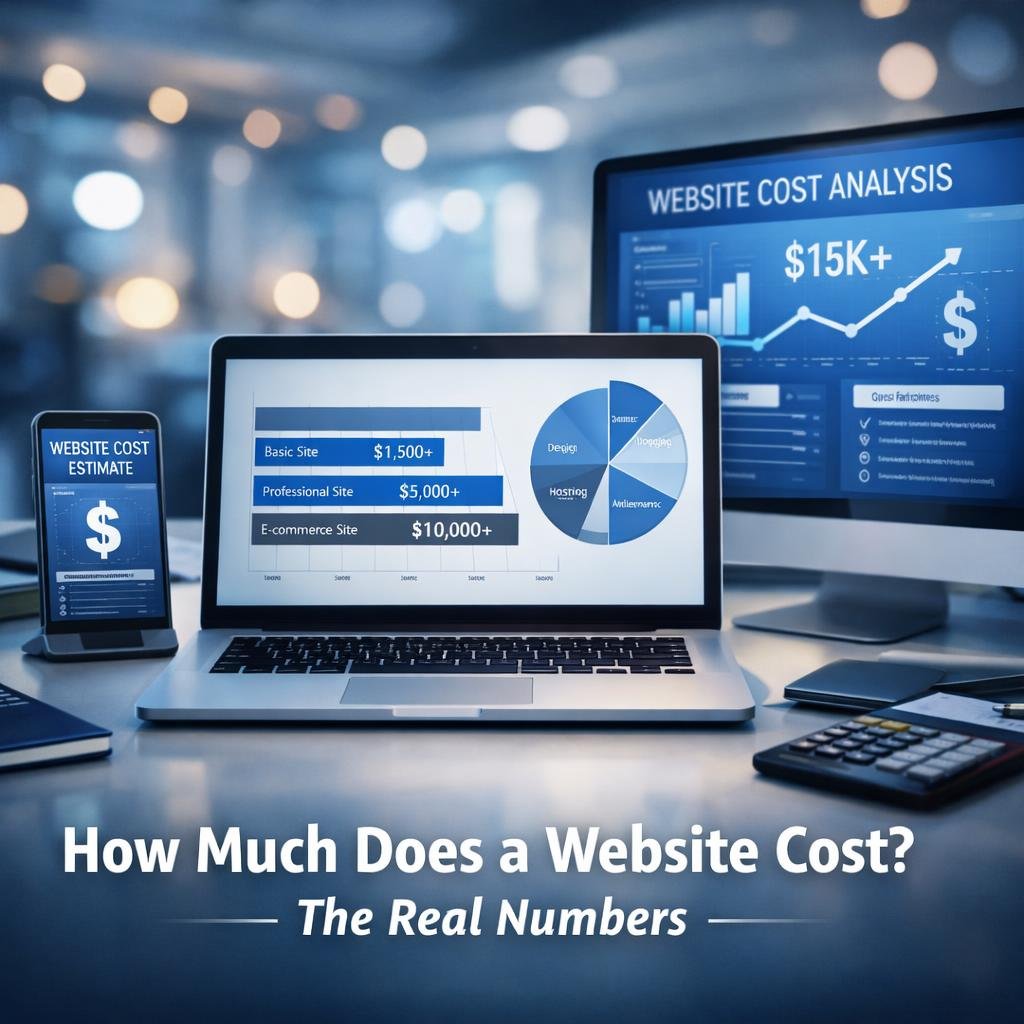
One of the most common questions business owners ask before starting a project is simple: how much does a website cost? The honest answer is that it depends on a lot of factors, and the range is wider than most people expect. You could spend a few hundred dollars or tens of thousands, and both outcomes can make sense depending on your goals.
The problem is that most pricing guides either oversimplify or overwhelm. They either say “it depends” without giving real numbers, or they dump a massive spreadsheet of variables that leaves you more confused than when you started. This article cuts through that noise and gives you actual cost ranges, broken down by approach, so you can make a smart decision for your budget.
Understanding website costs also means understanding what you’re actually paying for. Web development, web design, hosting, security, and ongoing maintenance all factor into the total picture. Whether you’re building a simple landing page or a full e-commerce website, knowing the real numbers upfront saves you from nasty surprises down the road.
What Determines Website Cost
Project Scope and Website Type
The single biggest driver of website cost is scope. A five-page small business site is a completely different project from a custom website with a content management system, user accounts, and hundreds of product pages. Defining your scope before you talk to anyone is the most important thing you can do.
Website type plays a huge role in pricing. Here are the most common categories and what they typically involve:
- Brochure or informational site: A few pages, basic contact form, minimal functionality
- Blog or content site: Ongoing publishing needs, categories, search functionality
- E-commerce website: Product listings, shopping cart, payment processing, inventory management
- Landing page: Single-page, conversion-focused, often used for ads or campaigns
- Membership or portal site: User logins, gated content, subscription management
- Custom web application: Unique functionality built from scratch, highest complexity
Each type carries a different price tag, and mixing types adds cost. An e-commerce website with a blog and a membership section is three projects in one. Be honest about what you actually need versus what sounds nice.
The table below gives a quick overview of how website type maps to general cost ranges.
| Website Type | Estimated Cost Range | Typical Build Approach |
|---|---|---|
| Basic Brochure Site | $500 – $3,000 | DIY builder or freelancer |
| Small Business Site | $2,000 – $10,000 | Freelancer or small agency |
| E-commerce Website | $5,000 – $50,000+ | Agency or custom development |
| Landing Page | $300 – $2,500 | DIY, freelancer, or template |
| Custom Web Application | $20,000 – $150,000+ | Specialized development team |
These numbers are starting points, not ceilings. Complexity, integrations, and the team you hire all push costs up or down significantly.
Design, Features, and Custom Development
Web design and web development are two different things, and both affect your budget. Design covers how your site looks, including layout, typography, color, and user experience. Development covers how it works, including code, databases, and integrations.
Using website templates dramatically reduces design costs. A pre-built template can cost anywhere from free to a few hundred dollars, while custom design from a professional web designer can run from $1,500 to $10,000 or more depending on complexity. Templates are a smart choice for budget-conscious projects, but they come with limitations in flexibility and uniqueness.
Custom development is where costs can escalate quickly. Features like booking systems, custom calculators, API integrations, or advanced search functionality require real engineering work. Each custom feature adds hours, and hours add dollars. Prioritize features that directly serve your users and cut anything that’s just nice to have.
Mobile responsive design is no longer optional. Every site needs to work well on phones and tablets, and building for every screen size adds complexity to the development process. If you want to understand what that actually involves, this breakdown of responsive web design and how it works across devices is worth reading before you finalize your feature list.
Search engine optimization also affects build costs. A site built with SEO best practices from the start, including clean code, fast load times, and proper structure, costs more upfront but saves money later. Retrofitting SEO onto a poorly built site is expensive and frustrating.
Common Website Cost Ranges
DIY Website Builders and WordPress
DIY website builders like Wix, Squarespace, and Weebly are the most affordable entry point. Monthly cost for these platforms typically runs between $15 and $50 per month, depending on the plan. That covers hosting, basic templates, and a drag-and-drop editor. Annual cost works out to roughly $180 to $600 per year.
These platforms are genuinely good for simple projects. A freelancer portfolio, a local service business, or a basic informational site can work well on a website builder. The tradeoff is limited customization and the fact that you’re locked into their ecosystem.
WordPress is a different story. As a content management system, WordPress powers a massive portion of the web. It’s free to use, but you’ll pay for hosting, a domain name, premium themes, and plugins. A self-hosted WordPress site can cost anywhere from $500 to $5,000 or more depending on how much customization you add.
- Free WordPress software, but hosting costs $5 to $50 per month
- Premium website templates range from $30 to $200 one-time
- Essential plugins can add $50 to $500 per year in licensing fees
- Page builder tools like Elementor or Divi add another $50 to $200 annually
WordPress gives you far more flexibility than a website builder, but it also requires more technical knowledge to manage. Many small business owners start on a builder and outgrow it, then move to WordPress or a custom build later.
Freelancers, Agencies, and Custom Builds
Hiring a freelancer is the middle ground between DIY and a full agency. A skilled freelancer can build a professional small business website for anywhere from $1,500 to $8,000. Rates vary widely based on experience, location, and specialization. A junior freelancer might charge $25 per hour while a senior specialist charges $150 or more.
The risk with freelancers is inconsistency. Some are excellent, some disappear mid-project, and vetting them takes time. Always check portfolios, ask for references, and use a written contract with clear milestones and payment terms.
Web agency pricing starts higher but typically includes a more structured process, a team of specialists, and ongoing support. A small web agency might charge $5,000 to $20,000 for a professional small business site. Larger agencies working on complex e-commerce or custom web applications can charge $50,000 to $200,000 or more.
Agencies are worth the investment when your project is complex, when you need ongoing support, or when your website is a primary revenue driver. For a local service business that just needs a clean, functional site, a good freelancer or a smaller boutique agency often delivers better value. If you’re building a site specifically to drive business growth, understanding how to turn your website into a lead generation tool should inform what features you actually need to budget for.
Custom builds sit at the top of the cost spectrum. These are sites built from scratch without relying on existing platforms or templates. They offer maximum flexibility and performance but require significant investment. Custom web development typically starts around $15,000 and can easily exceed $100,000 for complex projects.
Ongoing and Hidden Expenses
Domain, Hosting, and Security
The upfront build cost is only part of the picture. Ongoing expenses add up, and many people underestimate them when budgeting for a new site. Domain name registration typically costs $10 to $20 per year for a standard .com address. Premium or short domains can cost significantly more.
Web hosting is a recurring expense that varies based on your needs. Shared hosting is the cheapest option at $3 to $15 per month, but it’s slow and not suitable for high-traffic sites. Managed WordPress hosting runs $20 to $100 per month. Dedicated or cloud hosting for larger sites can cost $100 to $500 or more per month.
An SSL certificate is essential for any website. It encrypts data between your site and visitors, and it’s required for e-commerce. Many hosting providers include a basic SSL certificate for free, but premium SSL certificates with extended validation can cost $50 to $300 per year.
- Domain name: $10 to $20 per year
- Web hosting: $36 to $1,200+ per year depending on plan
- SSL certificate: Free to $300 per year
- Email hosting: $5 to $15 per user per month
- CDN services for speed: $0 to $50 per month
These costs are predictable and manageable, but they need to be factored into your total annual cost from the start.
Maintenance, Updates, and Add-Ons
Website maintenance is the expense most people forget about until something breaks. Keeping a site secure, updated, and functional requires ongoing attention. For a WordPress site, this means regular core updates, plugin updates, and security monitoring.
Many agencies and freelancers offer website maintenance packages ranging from $50 to $500 per month. What’s included varies widely, so read the fine print. Some packages cover only software updates, while others include content changes, performance monitoring, and security backups.
Neglecting maintenance is a false economy. A hacked or broken site costs far more to fix than a monthly maintenance plan. Security vulnerabilities in outdated plugins are one of the most common causes of website breaches, especially on WordPress sites.
Add-ons and integrations also carry ongoing costs. Email marketing tools, CRM integrations, live chat software, booking systems, and analytics platforms all have their own subscription fees. These can add $50 to $500 per month depending on what you use.
- Website maintenance plan: $50 to $500 per month
- Email marketing platform: $15 to $300 per month
- CRM integration: $25 to $150 per month
- Booking or scheduling software: $20 to $100 per month
- Premium analytics tools: $0 to $200 per month
A website redesign is another cost to plan for. Most sites need a significant refresh every few years to stay current with design trends, technology changes, and evolving user expectations. Budgeting for this from the start prevents sticker shock later.
How to Budget Wisely
Choosing the Right Build Approach
The right build approach depends on three things: your budget, your technical comfort level, and how central your website is to your business. A hobby blogger and a regional e-commerce business have completely different needs, and the same approach won’t serve both.
Start by defining your must-haves versus nice-to-haves. Must-haves are features your site cannot function without. Nice-to-haves are features that would be great but aren’t essential at launch. Build the must-haves first and add the rest over time.
For most small business owners, the choice comes down to a website builder, a WordPress site built by a freelancer, or a custom site from an agency. Here’s a simple way to think about it:
- Budget under $1,000: Use a website builder and do it yourself
- Budget $1,000 to $5,000: Hire a freelancer to build on WordPress
- Budget $5,000 to $20,000: Work with a boutique agency for a professional custom site
- Budget over $20,000: Engage a full-service agency for complex or high-traffic projects
Location also matters. A web design firm serving local businesses often provides better communication, faster turnaround, and more accountability than a remote team. For businesses in the Northeast, working with a team that understands the local market can make a real difference, as explored in this guide to web design built specifically for converting local business visitors.
Ways to Reduce Costs Without Sacrificing Quality
Cutting costs on a website doesn’t have to mean cutting quality. Smart decisions at the planning stage can save thousands without compromising the final result.
Use a quality template instead of custom design. Many premium website templates are professionally designed, mobile responsive, and highly customizable. Starting with a solid template and customizing it to your brand is far cheaper than designing from scratch.
Provide your own content. Writing your own copy and supplying your own photos saves significant money. Professional copywriting and photography can add $1,000 to $5,000 or more to a project. If you’re not a strong writer, at least provide a detailed brief so your developer or designer isn’t starting from nothing.
Phase your build. Launch with a lean, functional site and add features over time. This spreads costs, lets you validate what actually works, and prevents you from paying for features nobody uses.
- Use a premium template instead of custom design
- Write your own content or provide detailed briefs
- Phase the build and add features after launch
- Bundle services with one provider to reduce coordination costs
- Choose a platform that your team can update without developer help
Investing in search engine optimization from the start also reduces long-term costs. A site built with proper SEO structure drives organic website traffic without requiring constant paid advertising. For small businesses especially, combining good web design with a solid digital marketing strategy creates compounding returns. This overview of what actually works in digital marketing for small businesses is a useful companion to your website planning process.
Conclusion
Website costs range from a few hundred dollars to well over a hundred thousand, and both ends of that spectrum can be the right answer depending on your situation. The key is matching your investment to your actual goals, not to what sounds impressive or what a salesperson recommends.
Start with a clear scope, understand the ongoing costs beyond the build, and choose a build approach that fits your budget and technical capacity. A well-planned budget website that serves your customers effectively beats an overbuilt, expensive site that nobody can maintain.
Your website is an asset. Treat it like one, plan for it properly, and it will pay for itself many times over.
FAQ
How much does a basic website cost?
A basic website for a small business typically costs between $500 and $3,000. Using a website builder like Squarespace or Wix puts you at the lower end, while hiring a freelancer to build a simple WordPress site lands in the $1,500 to $3,000 range. This usually covers a handful of pages, basic web design, a domain name, and first-year hosting. Ongoing monthly cost after launch is typically $20 to $100 for hosting, maintenance, and any premium tools you use.
Is it cheaper to use a website builder or hire a professional?
A website builder is cheaper upfront. You can launch a functional site for under $500 using a platform with built-in templates and hosting. However, website builders have real limitations in customization, scalability, and search engine optimization. Hiring a professional web designer or freelancer costs more initially but often delivers a better result for businesses that need to compete online. The right choice depends on your goals, your budget, and how much your website matters to your revenue.
What ongoing costs should I expect after launch?
After launch, expect to pay for web hosting, domain name renewal, an SSL certificate, and any software subscriptions your site relies on. A realistic annual cost for a small business website runs between $500 and $2,000 per year for basic infrastructure. Add a website maintenance plan, email marketing tools, or CRM integrations and that number climbs. Budget for a website redesign every few years as well. These costs are manageable when planned for, but they catch many business owners off guard when they’re not factored in from the start.